"It's the kind of thing where these condos would fall into the ocean if we don't do this type of repair." That was Solana Beach Councilmember Kristi Becker, describing the state of the bluff beneath the Del Mar Beach Club condominiums in January 2024, when the City Council unanimously approved emergency repairs to 170 feet of seawall and staircase infrastructure below the complex at 825 S. Sierra Ave.
That vote wasn't an isolated crisis. It was a preview of a cost structure that runs through nearly every blufftop building along Solana Beach's South Sierra Avenue corridor, and one that rarely surfaces until a buyer is deep enough into a transaction that walking away feels expensive too. If you're shopping this corridor, the number that matters isn't the view premium or even the HOA dues line on the listing. It's a fee tied to the bluff itself, one that's structured to rise every year the ocean keeps doing what oceans do.
A Public Beach, a Private Wall, and a Rising Bill
Solana Beach's coastal bluffs are made of Torrey Sandstone, a soft formation that has been eroding since long before anyone built a condo on top of it. The city's response, formalized through its Shoreline and Coastal Bluff Protection Ordinance and refined since through multiple environmental reviews and coordination with the California Coastal Commission, treats the beach in front of a private seawall as what it actually is: public trust land. When a homeowner's association builds and maintains a wall on that sand, it's occupying public property, and the city charges for that occupancy.
The fee isn't fixed. It's indexed to erosion. As the beach in front of a wall narrows from the wall's own passive erosion effect, a well documented phenomenon where hard armoring accelerates sand loss in front of it, the annual charge increases. In 2026, that model was updated again to include recurring adjustments tied to ongoing erosion monitoring data rather than a number locked in at the time of permit approval. In practical terms, a seawall's carrying cost this year is not a reliable guide to its carrying cost five years from now.
That single design choice explains a lot about why HOA dues along this corridor can look modest on paper and then move. It also explains why nine separate condominium associations along South Sierra Avenue collectively pay the city millions of dollars a year to keep their seawalls in place, according to comments made by Surfsong HOA president John Steel during the Del Mar Beach Club repair discussion. That's not a one-time closing cost. It's a permanent, growing operating expense baked into every unit's monthly number.
Six Buildings, One Corridor, Different Math
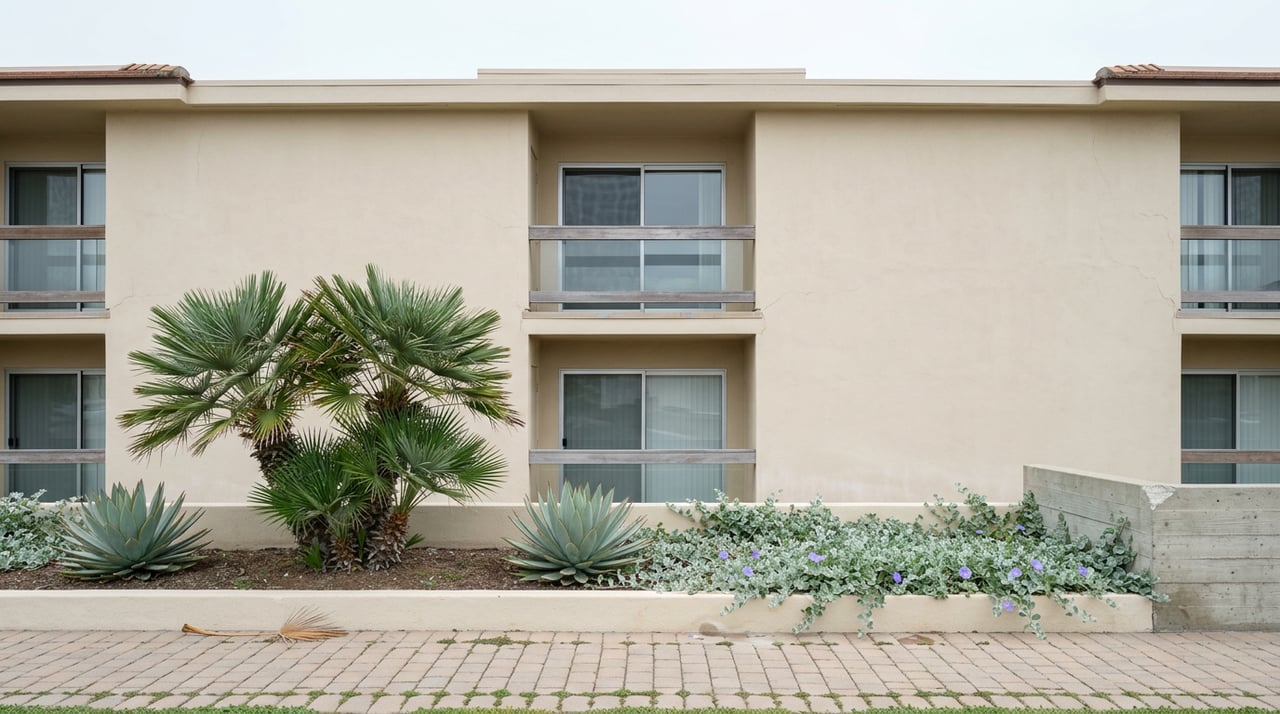
From Fletcher Cove south toward the Del Mar line, a run of gated condominium complexes sits directly on the bluff edge, most of them built in the early to mid 1970s, before the current version of California's coastal permitting framework existed. They look similar from the sand. Their financial exposure is not identical.
| Complex | Approx. units | Era built | What sets it apart |
|---|---|---|---|
| Seascape Sur | 188 | early-mid 1970s | Walking distance to the Del Mar racetrack and Cedros District |
| Del Mar Beach Club | 192 | early-mid 1970s | Site of the January 2024 emergency seawall repair, with 63 units in stacked towers directly above the bluff |
| Del Mar Shores Terrace | 86 | early-mid 1970s | South end of the corridor, closest to the Del Mar boundary |
| Surfsong | smaller | 1970s | Location of one of the more significant coastal bluff failures in recent San Diego County history |
| Seascape Shores | smaller | 1970s | Gated, with private staircase beach access |
| Solana Beach and Tennis Club | smaller | 1970s | Oceanfront with on-site tennis and pickleball, allows short-term rentals with a seven-day minimum |
Surfsong's history is worth sitting with. After a significant bluff failure, the HOA's engineering contractor built an emergency 35-foot seawall spanning the initial 120-foot failure site, then expanded the scope to roughly 800 lineal feet of hand-sculpted, color-treated shotcrete seawall, retention walls, and sea cave infill. Getting there required permits from five separate agencies: the City of Solana Beach, the California Coastal Commission, the California State Lands Commission, the Army Corps of Engineers, and the Regional Water Quality Control Board. That's the regulatory path a special assessment can travel down before a homeowner sees a bill.
The geotechnical review that triggered the Del Mar Beach Club repairs described the bluff condition in blunt terms, warning of "an active hazard to properties and persons living and/or working above the bluff profile." Repairs of that scale come with their own fee schedule. The city's estimate for the Del Mar Beach Club project included a sand mitigation impact fee of roughly $47,000 and a public recreation impact fee just over $200,000, on top of construction costs, for the first of three planned repair phases covering 540 feet of seawall total.
Permits Don't Age Out the Way You'd Expect
There's a second wrinkle specific to this corridor. A 2010 Coastal Development Permit authorized a 256-foot seawall fronting five single-family homes for a term of 20 years, tied to protecting development built before the Coastal Act. When the property owners later sought to amend that permit so the seawall's authorization would run for the life of the structures instead of expiring on a fixed date, the Surfrider Foundation testified against it, arguing that removing the 20-year review trigger meant losing the chance to reassess the wall as conditions changed. The Coastal Commission approved the amendment anyway, 7 to 1.
The lesson for a buyer isn't about that specific property. It's that seawall permits are not static documents. Their terms get amended, their triggers get renegotiated, and the outcome of that process directly affects whether a building's shoreline protection is guaranteed for another decade or subject to review at any point. A permit history that looks settled in a disclosure packet may not stay that way.
What the Median Price Won't Tell You
Solana Beach is a small city, home to roughly 13,000 residents packed into about four square miles, and its housing data reflects that scale. Over the three months ending April 2026, the median sale price citywide was $2.8 million, up 62.8 percent from the same period a year earlier, on just 36 recorded sales in April. A jump that size in a market that thin usually means the mix of homes selling shifted toward the high end, not that every property gained sixty percent in value. Broader home value estimates for the city as of late June 2026 actually showed a slight decline over the trailing year.
Neither number tells a buyer what a specific bluff-top unit at Del Mar Beach Club or Seascape Sur is worth, because neither number accounts for which building you're in, what phase of seawall repair it's in, or how its HOA reserve study is funded. In a corridor where six similar-looking buildings carry six different erosion exposures, the citywide median is close to meaningless as a pricing tool. What matters is the building-specific paper trail.
The Paper Trail Before You Write an Offer
Before making an offer on a unit in any of these buildings, ask for documentation on each of the following:
- The HOA's most recent reserve study, and whether it specifically funds bluff stabilization or seawall maintenance as a line item, not just general capital reserves
- Any pending or recently completed special assessment tied to shoreline armoring, drilled pier walls, or staircase repair
- The seawall's current Coastal Development Permit, including its term, any amendments, and whether it's tied to a fixed expiration or to the life of the structure
- A current or recent geotechnical letter describing the bluff's condition, not one written before the last major storm season
- Whether the building's annual landlease or encroachment fee to the city has increased in recent years, and by how much
A seller and their HOA should be able to produce most of this without much delay. If they can't, that's information too.
FAQ
What is Solana Beach's landlease fee for seawalls? It's an annual charge the city assesses on property owners whose private seawalls occupy public beach land, adjusted based on documented erosion. As of the 2026 update, the fee includes recurring adjustments tied to erosion monitoring rather than being fixed at the time of permit approval.
Does a 1970s-era building have to meet today's bluff setback rules? Not automatically. Solana Beach's current Geologic Setback Line reflects historic erosion rates and sea level rise projections that didn't exist when most of the Sierra Avenue corridor was built, so many existing structures sit closer to the bluff edge than new construction would be permitted to today. That grandfathered status is a reason to review permit history carefully rather than assume current rules apply retroactively.
Is the seawall fee something a buyer pays directly, or is it folded into HOA dues? For condominium buildings, the city's fee is typically assessed to the association, which then factors it into dues or special assessments. A buyer of a single-family blufftop home would be responsible for the fee directly if their property carries its own seawall permit.
Bluff-top ownership in Solana Beach isn't a bad decision. It's a decision that requires reading past the view and the price and into a building's specific relationship with its own seawall. If you're weighing a unit in this corridor, or comparing it against similar coastal product in Del Mar, Cardiff, or Encinitas, I can help you pull the permit history and HOA financials before you're several weeks into escrow. Reach out to Aaron Castagna and let's connect.